Be yourself; Everyone else is already taken.
— Oscar Wilde.
This is the first post on my new blog. I’m just getting this new blog going, so stay tuned for more. Subscribe below to get notified when I post new updates.
EURR4303 Blog for the 2022 Fall Semester- Published by Jacob Braun
Be yourself; Everyone else is already taken.
— Oscar Wilde.
This is the first post on my new blog. I’m just getting this new blog going, so stay tuned for more. Subscribe below to get notified when I post new updates.
By Jacob Braun

Giorgia Meloni holding up a scarf that reads “We defend God, Homeland and Family,” Massimo Paolone/AP, via the Guardian
The election of Giorgia Meloni as Italian Prime Minister reflects a significant change in the landscape of Italian politics. Regionalist squabbles were put down to support a candidate rooted in traditions all Italians could relate to, who supposedly would fight in their corner against the entrenched liberal European order centered in Brussels. Fratelli d’Italia brought together the varied identities of Italy and pointed them at a single target; if their campaign was so effective, what does this mean for the future?
SYMBOLISM
It is no coincidence Meloni’s party is named Fratelli d’Italia. Translated into english it means “brothers of Italy,” and it is also the name of the country’s national anthem. The anthem itself evokes much of Italy’s rich history from the Romans to their conquest of territories from Austria-Hungary, promoting the underlying notion that throughout all of time Italians have fought bravely alongside one another as equals and heroes. Using this imagery, Meloni weaved in her populist tactics and brought the party to the parliament.
TRADITION
The imagery co-opted by the FdI also evokes a strong traditional message. This is especially apparent when considering Meloni’s staunch desire to put God, fatherland and family first in the lives of Italians. These traditions transcend regional borders, and unite the historically rivaled north and south in a campaign against those perceived to be threatening christendom and the status quo familial structure.
LOOKING AHEAD
Looking to the future, a multitude of different things could happen under the Meloni government. Perhaps we’ll see her go through with the anti-immigration naval blockade and also cut ties with the EU in an Italexit, or Meloni might maintain EU connections in the face of the conflict in Ukraine. I can be sure though that Meloni will stand by her traditionalist stances and will do her best to maintain a north-south identity alliance. Silver lining is, the election turnout for Meloni was only 64%—a surprisingly low number. Maybe all of our fears are overblown, and there is no real power behind the Meloni cabinet. Nevertheless, the next few years will be quite turbulent for Europe. I can only be thankful I can watch them from a distance here in Canada.
By Jacob Braun

Entrance of Garibaldi to Naples (1860), Wenzel Franz Jager, via WikiMedia Commons Attribution-Share Alike 3.0 Unported
On the surface, Italy and Germany seem like polar opposites of each other. Italy is Catholic, while Germany is Protestant. Italians love to relax, while Germans are typically stereotyped as workaholics. Italian is a Romance language, and German is of Germanic origin. However, both states can trace a lot of common factors together in their origin stories. By looking to the past at unification and the birth of fascism, we can glean some insight into Italy’s populist present. (If anyone is interested in brushing up on their knowledge of Italian and German unification, watch this video by Crash Course!)
UNIFICATION- TROUBLES OF IDENTITY
Both Germany and Italy united primarily using negative integration—that is to say they attacked a defined outsider in order to group together their own national community. Before unification both nations were made up of multiple different states (maps of Germany, Italy) who identified as independent rather than as part of a greater nation. As a result, regionalism still persists in both Germany and Italy and is a tool populists love to exploit.
FASCIST PASTS- AND MEASURES AGAINST RESURGENCE
The aftermath of the First World War would set the foundations for a resurgence in nationalist fervor among the vanquished nations, thus birthing fascism (this grossly oversimplifies the origin of fascism, read this to learn in-depth). The Second World War would largely eradicate fascist presence in Europe, legislating explicitly against fascist party operations. In Italy however, fascist-adjacent parties were allowed to exist despite laws existing against them.
POPULIST PRESENT
As a result of the inaction against neo-fascist political parties in Italy, those parties would be able to regroup and re-assess the political landscape and essentially rebrand themselves to be palatable for the public. Populist parties would emerge, bringing a new energy to the table in contrast to their aging neo-fascist counterparts. Starting on the regional stage then evolving to the national, Populist politicians used new tactics with old messages to gain power.
By Jacob Braun

Self portrait of Renaud Camus in 2019, Renaud Camus, via WikiMedia Commons Attribution 2.0 Generic
Inspired by British author Enoch Powell and French author Jean Raspail, Renaud Camus brought the concept of western civilization’s downfall to the political limelight. Immigrants were to blame for this event—supposedly supplanting the rightful place of the white European man. This insidious rhetoric would be responsible for two devastating mass shootings in Christchurch, New Zealand (2019) and in Buffalo, USA (2022). In Italy, Prime Minister Giorgia Meloni subscribes to the “Great Replacement” as fact and is trying to combat it with pro-natalist and anti-migrant policies.
PRO-NATALISM
Meloni used her status as a mother as a significant pillar of her Italian electoral campaign. She encourages women to have families and assume domestic roles to produce the workforce Italy needs to outpace migration. Although Meloni has not said she’d ban abortion, she does support conscientious objection from doctors. It all boils down to Italy needing a strong birth rate to keep Italians in the nation at number one on the demographics list, under the fear that they will be outnumbered by migrants coming from the Middle East and North Africa.
ANTI-IMMIGRATION
Meloni’s anti-immigration platform works hand in hand with her pro-natalist platform. With a stronger birth rate ruling out domestic issues, a proposed naval blockade surrounding Italy would rule out any foreign issues surrounding immigration. According to her however, this is done out of concern for the migrant lives lost trying to cross the Mediterranean. The conflicts in the Middle East and North Africa have allowed populist leaders like Meloni to politicize their victims, demanding their repatriation back to their wartorn homelands to keep Italy Italian.
By Jacob Braun

Ultras of Lazio in the Stadio Olimpico in Rome, Andrea Buratti, via WikiMedia Commons Attribution-Share Alike 3.0 Unported
It should go without saying that football is really, really big in Italy. When I lived in Florence for a couple months, I even bought a pair of ACF Fiorentina (AKA “Viola” because of the purple color of their uniforms) shorts to fit in with the crowd. However, I would not be caught dead wearing those shorts outside of Florence. Who you root for on the pitch is a big part of life in Italy, and is the source of right-wing popularization among primarily young male spectators. Let’s delve into that!
IT STARTS WITH COMMUNITY
Italy’s victory in the 1982 World Cup against Spain kickstarted the “footballization” of Italian society. Then President Sandro Pertini synthesized his political presence with Italy’s win, promoting a massive national sense of community among a traditionally regionalized country. The football stadium became a bridge between politicians and fans of the game, which would morph as the political geography of Italy did.
RISE IN THE RIGHT-WING
As much as football unites in Italy, it divides. The 1982 moment of Italian community is looked upon as a watershed moment, but regionalism has since superseded its nationalist sentiments. A fierce divide between the north and south can be often found at games between northern and southern clubs, surpassing playful banter. From these divides regionalist right-wing groups rise—such as the infamous Ultras.
FOOTBALL HOOLIGANS AND GOVERNMENT
The state of football in Italy reflects the state of its greater society. So, it’s worrying that neo-nazi groups like the Ultras are so big at Italian stadiums. It is equally worrying that groups like the Ultras are associated with regionalist political parties in Italy, like the former Lega Nord (which is now just La Lega). With the popularity of Italian populist politics at an all-time high after Giorgia Meloni’s election, ideas propagated by the Ultras could find their way (albeit in a diluted state) into the halls of Italian parliament.
By Jacob Braun

The “Arrowed Turtle,” the logo for the Italian neofascist CasaPound Party, CasaPound, via WikiMedia Commons
The former Italian political party CasaPound is a neo-fascist, identitarian social movement that regularly espouses the ideas of Benito Mussolini and National Socialism. Although the movement may be relegated to the fringe in Italian politics, some of its political aims have snaked their way into the current Italian parliament. This blog post will aim to answer the question: how did they manage that?

The Identitarian Lambda, primarily used by European Identitarian groups inspired by Spartan Shields in the movie 300, Wikimedia Commons, Public Domain
IDENTITARIANISM
Identitarianism originates from the French Bloc Identitaire movement and has since exploded across Europe, propagated by essayists such as Alain de Benoist and Renaud Camus. It is a racist, anti-Muslim, anti-immigration movement that seeks to preserve “European heritage” by rejecting multiculturalism and upholding white supremacy. They promote Christian values against what they claim to be the forced Islamization of Europe—the very definition of a Trumpist, “my country first!” type populism.
RESPECTABLE DISCOURSE
Identitarianism as a political movement in Italy did not attract enough voters to give it much weight in parliament or any provincial politics, which is why the party ceased functioning in 2019. However as a social movement, Identitarianism has been able to attract Italian citizens concerned with the transnational nature of the European Union. The Identitarian movement carried by their CasaPound vessel was able to bridge the gap between fringe and respectable, allowing its politics to enter parliament.
LINK TO FdI
CasaPound’s policies are found in the repertoire of the Fratelli d’Italia. Both parties hold harsh views against immigration to Italy, proposing some sort of military intervention to solve the issue. Additionally, both parties raise questions about Italy’s presence in the EU; a worrying thought.
By Jacob Braun

Giorgia Meloni and the center-right coalition at the Quirinal Palace, Quirinale, via WikiMedia Commons
On October 22, 2022, Giorgia Meloni, leader of the far-right Fratelli D’Italia party, became Prime Minister of the Italian Republic. Based on a platform of anti-establishment rhetoric and populist nativism, Meloni’s coalition would take 44% of the vote— a resounding majority compared to her leftist opponents. As of yet, it is too early to determine Italy’s future under the new PM, but it will certainly be a blast to the past. As the phase of full populist transition ends, the battle for a new Italian identity begins.
FdI ORIGINS
Fratelli D’Italia (or Brothers of Italy) emerged primarily from two neo-fascist Italian political parties: the Movimento Sociale Italiano and the Alleanza Nazionale. The party itself is relatively new having been founded in 2012, touted by Meloni as a “new party for old tradition. Built on the populist pillars of sovereignty, national unity and traditional values, the Fratelli D’Italia aimed to capture voters dissatisfied with the status quo of Italian politics (especially after Covid-19 and a sustained migrant crisis). Though the Fratelli D’Italia have roots in Italy’s fascist past, that did not seem to hinder their victory.
BRINGING FASCISM TO THE MAINSTREAM
The Fratelli D’Italia seem to be on a fine line of being considered fascist, or just part of the far-right wing. The party has gone through a significant amount of rebranding to make ties to its past more palatable, but it still attracts many who would hope to see a Mussolini-like restoration. Heck, the party’s slogan is still “God, family, fatherland,” which evokes the fascist past. Now in the mainstream of Italian politics, the Fratelli D’Italia have seemingly swung even further right— following the likes of Viktor Orban with an emphasis being placed on having children and making families, as well as an ardently anti-immigrant stance.

Giorgia Meloni at CPAC 2022, VOX Spain, via WikiMedia Commons Public Domain
WHAT COULD THIS MEAN?
As we come to the end of the transition period in this blog, a new phase of creation is evidently beginning in Italian politics. In my opinion, I believe the new government will focus on forging a new “Italian identity” within Europe— which could foreseeably have consequences which affect the EU or even NATO. As of yet, I think it’s too early to tell concretely what might happen. Until next time, ciao!
By Jacob Braun

Italian Customs boat enters port in southern Italy with Syrian Refugees, UNHCR/F.Noy, Copyright
Spurred on by widespread unrest within the Arab world caused by the 2011 Arab Spring protests, the Syrian Arab Republic was flung into a brutal civil war in early March of the same year. Until the breakout of the Russo-Ukrainian War, the Syrian Civil War would be the source of the largest refugee crisis in human history since the Second World War. With large amounts of majority Arabic, Muslim immigrants crossing the Mediterranean into Italy and Greece, a chain of events would unfold leading to an explosion in populist rhetoric within the EU.
A DECADE OF CRISIS
On entering the new millennium, the geopolitical landscape of the Mediterranean would change dramatically. Dictatorial regimes like Ben Ali’s in Tunisia and Qaddafi’s in Libya would be overthrown with the Arab Spring— with Al Assad’s regime seemingly up next on the chopping block. Through the ensuing civil wars and political upheavals, thousands of migrants would cross the Mediterranean to seek the safe shores of Italy or Greece as access points deeper into Europe.
POLITICIZING MIGRANTS
In the years following 2015, Populist parties in opposition to the Renzi and Gentiloni governments capitalized on their failures to revitalize the Italian economy as a result of a “migrant invasion.” Support for movements like the 5 Star Movement led by Beppe Grillo experienced a surge in recognition, popularizing anti-immigrant and anti-EU rhetoric within the Italian parliament. For instance, the former Interior Minister Matteo Salvini was notorious for his hardline stance on refugees coming from across the Mediterranean, having held aspirations to deport 500,000 immigrants as well as having declared Tunisia a country that exports convicts to Italy.
LEAD-UP TO MELONI
Years of sustained populist rhetoric in the Italian parliament as a result of capitalizing on the Syrian Refugee crisis significantly shifted the political landscape much more in favor of the Italian right-wing. Because of this, I’d argue it was almost predictable that when another “political outsider” similar to Berlusconi entered the political arena campaigning “for the people,” they would be a ballot-box-office hit. This moment would arrive with Giorgia Meloni and her Fratelli d’Italia, who ring quite similar to the Trumpist Republicans of the United States.
By Jacob Braun

Silvio Berlusconi, Italian House of Representatives 1994, via WikiMedia Commons Public Domain
Coming out of the major scandals that rocked the Christian Democrats and Italian Socialists, an unlikely political outsider takes the reins of Italy in the 1994 election: Silvio Berlusconi. Poised on bringing populist politics into the spotlight, Berlusconi and his centre-right coalition Forza Italia would prime the Second Republic to be a conservative European stronghold. Along with the official formation of the European Union in 1993, Berlusconi’s populism would prove to be beneficial to fellow conservatives later down the line…
POST-FASCISTS BACK IN FASHION
Berlusconi’s Forza Italia party was the main point of a three-party alliance which also included Lega Nord and the Alleanza Nazionale. These radical right-wing parties were strongly associated with the new Prime Minister’s anti-elitist and anti-corruption platform. Most notably, Alleanza Nazionale is the direct successor of the old postwar neofascist Movimento Sociale Italiano (Italian Social Movement)— which marks a distinct turning point in Italian politics. With the election of Berlusconi, parties which were once shunned as fascist and extremist were able to re-enter the spotlight because of their reinvention over the course of the 20th century.
POPULIST TRANSFORMATION
Italy would change wildly in its attitudes to its role in the European Union during the new millennium. Especially after the fears of 9/11 and the Global Recession of 2008, the Berlusconi government made its issues with EU “interference” very public. This culture of blaming Brussels for domestic political reasons became entrenched in Italy going into the 2010s, practically catapulting euroscepticism in the country into the mainstream. With the help of Berlusconi the Second Republic was kickstarted as one governed by populism, whose pillars would only be reinforced in the aftermath of the refugee crisis caused by the Syrian Civil War.

Asylum Applicants in Europe between 1 Jan. and 30 Jun. 2015, Maximilian Dörrbecker, via WikiMedia Commons Attribution-Share Alike 2.0 Generic
By Jacob Braun
Former Italian Prime Minister Benedetto Craxi, Unknown Author, via WikiMedia Commons Public Domain
For the first time since the Second World War, a Socialist Party in Italy came to power with Benedetto “Bettino” Craxi as its Prime Minister in 1983. With promises of reform and continued efforts to improve the economy from a devastating recession, the situation in Italy seemed to be getting better as the Years of Lead came to a close. Corruption and scandal would rock the Craxi government, putting an end to the First Republic and giving rise to a new, populist type of politician.
DOWNWARD SPIRAL
Under the Craxi government, Italian inflation rates would drastically be reduced in tandem with the reduction of the indexation of wages. However, the growth of the economy spurred on by this change would incur unsustainable fiscal deficits, plunging Italy into a long-lasting cycle of debt repayment. All the while, Prime Minister Craxi lived an opulent lifestyle at the hotel Raphael while regular Italians struggled to make ends meet with an increasingly weakening Lira.
Benedetto Craxi being greeted by a salvo of coins, Robin Alves, via WikiMedia Commons Attribution-Share Alike 3.0 Unported
DEATH OF THE REPUBLIC
In 1987, the Christian Democrat party withdrew their support of the Craxi government resulting in Benedetto Craxi’s resignation as Prime Minister. In 1992 a nationwide corruption scandal would be uncovered, implicating many DC and PSI politicians. The political landscape would be changed forever, seeing the disappearance of the Christian Democrat and Socialist parties, among others implicated in the scandal. The Italian First Republic was decidedly dead— but a new type of politician was looking to pick up the pieces and build back a better Second Republic.
THE RIGHT-WING RE-EMERGES
A media tycoon and coincidentally a friend of Benedetto Craxi, Silvio Berlusconi would become Prime Minister of Italy in 1994. The centre-right in a coalition with the Northern League and the National Alliance would take power on a platform of anti-corruption, guaranteed freedoms and small government. Populism took its hold on Italian politics with Berlusconi, paving the way for a wider populist movement within the European Union moving into the 21st century. The Second Republic would begin out of disdain for the First— was populism thus destined to take root in Italy?
By Jacob Braun
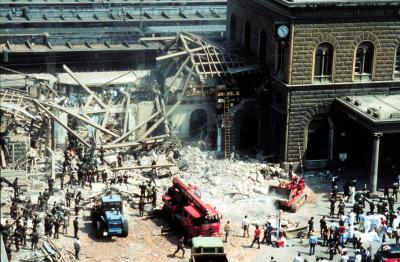
A Photo of the Aftermath of the Bologna Massacre, Beppe Briguglio, via WikiMedia Commons Attribution-Share Alike 4.0 International license
The Years of Lead (Anni di Piombo) began with the Hot Autumn strikes of 1969, where massive amounts of workers joined students protesting for social reforms in a similar fashion to the May 1968 demonstrations in France. Violence from both left- and right-wing sources would emerge, and for 15 terrible years the internal cohesion of the Italian First Republic was truly put to the test. This blog post looks to answer: is its failure what set us in motion to where we are now in 2022?
HISTORIC COMPROMISE AND SIFAR
In efforts to avoid an economic collapse following the Hot Autumn, the Christian Democratic Party reached out in a historical compromise (compromesso storico) with the Communist Party. With the tensions of the ongoing Cold War and fears of a Communist takeover within NATO, the conservative anti-communist governments of the time weren’t too thrilled. Thus, General Giovanni de Lorenzo prepared an emergency plan to be undertaken by the Carabinieri Arma (Solo Plan) to take over the government in the case of such an eventuality. This affair would be found out in 1964 and the SIFAR would be disbanded, but that didn’t stop the Italian government from undertaking a different strategy towards the violence in the decades to come.
STRATEGY OF TENSION
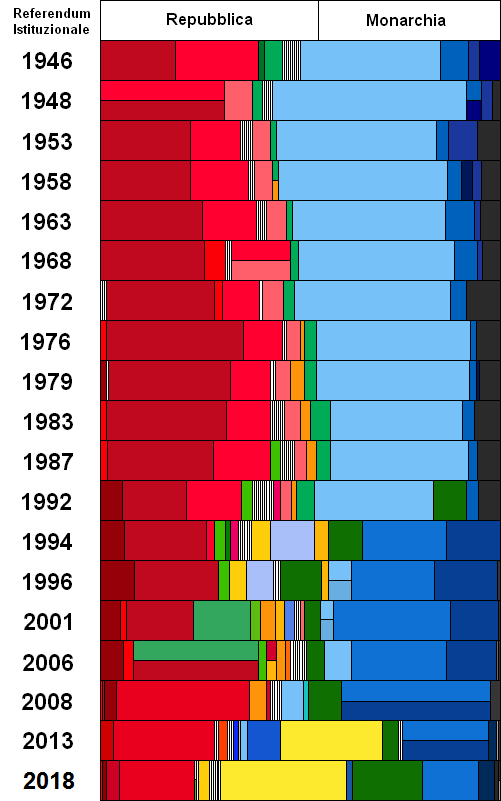
The Italian government in its quest for stability ostensibly collaborated with far right-wing groups in blaming attacks during the Years of Lead on far left-wing groups to popularize authoritarian policies amongst the people. This would essentially cement right-wing dominance in Italian politics to this day, morphing Italy into a stronghold of conservative politics.
Elections in Italy since 1946, Nick Mon, via WikiMedia Commons Attribution-Share Alike 4.0 International license
THE FIRST REPUBLIC ON ITS LAST LEGS
The political violence, scandals and corruption of the Years of Lead (we’ll go into the corruption in my next post!) almost irreparably destabilized Italy. It has certainly left its mark, seeing as about 53 years later Italians are still haunted by it. A transition period would be set in motion by the Years of Lead, paving the way for populist rhetoric to decisively entrench itself in the echelons of Italian government. I aim to post about the development of this populist rhetoric across the transition period from the Years of Lead to now, so hopefully this will all make sense once I’ve posted the rest of this “timeline.”
Ciao, until next time!


 The Plague of Populism


.jpg)


.jpg)


